
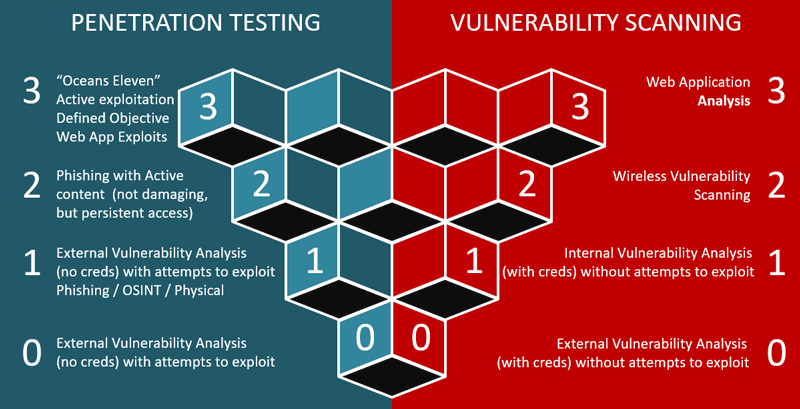
Vulnerability Assessment vs. Penetration Testing
Here is a quick breakdown and refinement of the two concepts to make the distinctions perfectly clear, correcting a few minor grammatical errors along the way:
Penetration Testing (Pen Testing)
Penetration testing is the process of finding vulnerabilities, malicious content, flaws, and risks by actively trying to exploit them. Its primary purpose is to strengthen an organization's security posture and defend its IT infrastructure.
- Nature: It is a controlled, authorized, and official procedure rather than a malicious attack.
- Focus: It is a specific subset of ethical hacking that focuses heavily on actively breaching defense systems to see how far an attacker could get.
Vulnerability Assessment (VA)
A vulnerability assessment is the technique of identifying, measuring, and ranking security vulnerabilities (via scanning) within a given environment. It provides an all-embracing evaluation of the overall information security posture.
- Nature: It is a comprehensive diagnostic scanning and result analysis process.
- Focus: It identifies potential weaknesses and provides proper mitigation measures to either completely remove those gaps or reduce them to an acceptable risk level.
Summary of the Difference
| Feature | Vulnerability Assessment | Penetration Testing |
|---|---|---|
| Approach | Passive/Diagnostic: Identifies and lists known weaknesses without exploiting them. | Active/Simulated Attack: Actively exploits vulnerabilities to see what data or systems can be compromised. |
| Scope | Wide and comprehensive across the entire infrastructure. | Narrow and deep, focusing on specific targets or attack paths. |
| Outcome | A list of vulnerabilities ranked by severity with remediation advice. | Proof of concept (PoC) showing how a defense was breached and the potential impact. |
Here is a refined, structured, and polished version of the key features for both Vulnerability Assessment (VA) and Penetration Testing (PT). The language has been cleaned up for professional clarity, removing repetitive phrasing while keeping it highly scannable.
Key Features of Vulnerability Assessment (VA)
A Vulnerability Assessment is primarily a diagnostic process. Its key features include:
- Automated & Manual Testing: Combines background automated scanners with manual checks to analyze networks, systems, applications, and hardware devices.
- Comprehensive Asset Coverage: Scans all internal and external attack surfaces, vectors, and potential entry points to eliminate security blind spots.
- Risk-Based Prioritization: Categorizes and ranks detected vulnerabilities based on their severity, exploitability, and potential business impact, helping optimize resource allocation.
- Continuous & Scheduled Scanning: Operates as an ongoing, real-time, or scheduled practice rather than a one-time event, ensuring constant visibility into the organization's security posture.
- Detailed & Actionable Reporting: Provides visual reports (graphs, charts, heat maps) with clear remediation steps, while helping fulfill regulatory compliance standards such as PCI-DSS, HIPAA, and ISO 27001.
- Seamless Integration: Integrates smoothly with Security Information and Event Management (SIEM) systems, Intrusion Detection Systems (IDS), and patch management solutions to correlate data and add threat context.
- Customizable Testing: Allows organizations to define the scope, testing frequency, and asset priority, focusing heavily on critical infrastructure.
Key Features of Penetration Testing (Pen Testing)
Penetration Testing is a simulated cyberattack designed to proactively find and exploit security issues.
Core Questions It Answers:
- What is the actual strength of our current security posture under attack?
- Are our security controls compliant with the latest regulatory standards?
- How can we prevent data breaches, lawsuits, and costly financial fines?
How It Works:
[1] Information Gathering ➔ [2] Vulnerability Scanning ➔ [3] Active Exploitation ➔ [4] Post-Exploitation (Foothold) ➔ [5] Reporting & Remediation
Key Features:
- Real-World Attack Simulation: Mimics actual techniques, tactics, and procedures (TTPs) used by malicious hackers to test how your defenses hold up in real time.
- Manual, Human-Driven Expertise: Relies on the creativity and critical thinking of skilled security professionals to uncover complex attack chains and business logic flaws that automated scanners miss.
- In-Depth Security Analysis: Goes deep into the security architecture to map out potential attack paths, analyzing how multiple minor vulnerabilities can be chained together for a major breach.
- Exploitation & Post-Exploitation Analysis: Actively breaches defense lines to determine exactly what data could be exfiltrated, which systems could be compromised, and how long a persistent foothold can be maintained.
- Comprehensive Remediation Insights: Delivers detailed reports containing a step-by-step documentation of the attack path, evidence of exploitation (proof of concept), and a prioritized fix list.