Fiber Optic Cable
Overview:
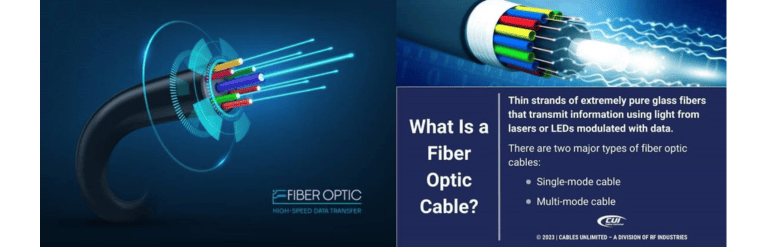
Fiber optic cables are high-speed data transmission mediums using light pulses through glass/plastic strands, offering superior bandwidth, low attenuation, and immunity to electromagnetic interference.
Common Fiber Types:
- Single-mode (OS1/OS2): Optimized for long-distance, high-bandwidth (yellow jacket).
- Multimode (OM1-OM5): Optimized for shorter distances, such as data centers (orange/aqua jacket).
- Plastic Optical Fiber (POF): For short, low-speed networks; large 1.6 mm core. Performance Characteristics
- Immunity: Non-conductive, immune to EMI/RFI.
- Speed: Near-instantaneous transmission.
- Connector Loss: Typical $0.2–0.5$ dB loss per connector.
Understanding Fiber Optic Cables: Technology & Specifications
Fiber optic cables are the backbone of modern high-speed data transmission. By transmitting data as pulses of light through ultra-thin glass or plastic strands, fiber optics offer vastly superior bandwidth, minimal signal loss, and complete immunity to electromagnetic interference (EMI) compared to traditional copper wiring.
Anatomical Structure of a Fiber Optic Cable:
Every fiber optic cable is engineered with multiple protective and functional layers to ensure light pulses travel seamlessly over long distances.
- Core: The innermost strand made of high-purity silica glass or plastic. This is the actual pathway that transmits light.
- Cladding: A layer surrounding the core with a lower refractive index. It acts like a mirror, reflecting light back into the core via total internal reflection to prevent signal loss.
- Strength Members: Woven Aramid (Kevlar) yarn designed to absorb pulling tension and prevent the internal fibers from stretching or snapping during installation.
- Outer Jacket: An environmental casing made of Polyethylene (PE) or PVC that protects the inner components from weather, abrasions, and chemicals.
Key Performance Characteristics:
- Near-Instantaneous Speed: Light-speed data transmission ensures minimal latency.
- EMI/RFI Immunity: Because the cable is completely non-conductive, it is entirely immune to electromagnetic and radio frequency interference.
- Single-Mode vs. Multimode Fiber Fiber optic cables are broadly categorized into Single-mode and Multimode, each engineered for specific deployment scopes and distances.
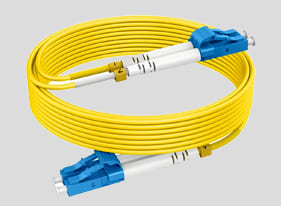
Single-mode Fiber (SMF - OS1/OS2)
The optical fiber patch cords are suitable for data communication, telecommunication applications. The terminated connectors in assemblies are designed to and are compatible with industry standards
Get Price Download Datasheet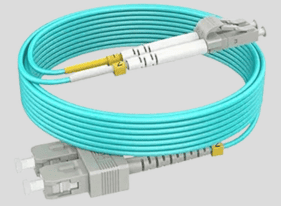
Multimode Fiber (MMF -OM1/OM2/OM3/OM4/OM5)
UTP 23AWG Solid:305M Enhanced performance cable for transmission of high speed data, digital and analogue voice and video (RGB) signals on LANs.
Get Price Download Datasheet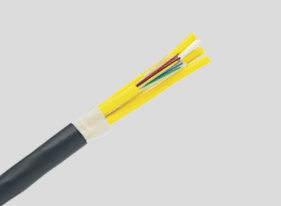
Single-mode Fiber (SMF - OS1/OS2)- unarmoured
Passive networking components form the essential backbone...
Get Price Download Datasheet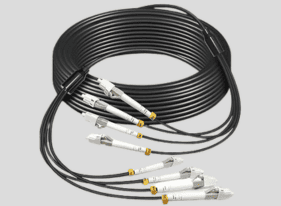
Multimode Fiber (MMF -OM1/OM2/OM3/OM4/OM5- Armoured)
CAT6 UTP Armored Cat6 UTP 23AWG Twisted Pair Armored Cable:305M Enhanced performance cable for transmission of high-speed data
Get Price Download Datasheet